What is Ideogram?
Ideogram is an AI image generator built around one core competency: rendering readable, accurate text natively inside generated images. While most AI image tools produce garbled letters and nonsense words when asked to include typography, Ideogram embeds text directly into the image synthesis process — no post-generation overlay required. The output is logos, posters, and marketing graphics where the words actually say what you typed.
Version 3.0 is the current release as of 2026 and ships with dedicated style modes tailored to common commercial use cases: Logo, Poster, Marketing, and Print. A free tier is available for evaluation, with paid plans for higher volume and private generations.
Key Features
- Native text rendering — text is generated as part of the image, not overlaid afterward, so letterforms integrate naturally with composition and lighting.
- Dedicated style modes — Logo, Poster, Marketing, and Print modes tune the model toward each use case without requiring complex prompt engineering.
- High prompt adherence — Ideogram follows typography instructions (font style, placement, content) more reliably than general-purpose generators.
- API access — developers can integrate Ideogram generation into their own tools and workflows.
- Free tier — available for genuine evaluation with functional limits on queue speed and image privacy.
Ideogram 3.0: Text Accuracy in Practice
The central claim behind Ideogram 3.0 is text accuracy. Third-party testing reported by AI Tool Radar places Ideogram 3.0 at 90–95% text accuracy — meaning the words, punctuation, and spacing you specify appear correctly in the generated image the overwhelming majority of the time.
To put that in context: most general-purpose AI image generators fail to render even short phrases reliably. Midjourney, FLUX, and DALL·E historically produce readable text only on short words and even then inconsistently. Ideogram’s architecture prioritizes text synthesis from the ground up, which is why it built its reputation around logos, posters, and signage rather than photorealism.
On the independent Sonnet leaderboard tracked by VibeDex, Ideogram 3.0 ranks 10th out of 18 models with a score of 3.913 — trailing Seedream 4.5 by a notable margin but leading FLUX.2 Pro. That ranking reflects overall image quality across all criteria. For text-specific work, Ideogram’s lead over most alternatives remains meaningful.
Use Cases Where Ideogram Excels
- Logo design drafts — generate multiple logo concepts with real, readable wordmarks in seconds
- Event and promotional posters — text-heavy designs with dates, names, and slogans rendered correctly
- Social media graphics — quote cards, announcement posts, product callout images
- Packaging mockups and signage — accurate label text for product visualization
- Marketing ads — headlines and CTAs embedded naturally in the image composition
Pricing
Ideogram offers a free tier that is functional but limited: generation queues are slower and all images are public by default. This makes it suitable for testing the tool but impractical for client or commercial work.
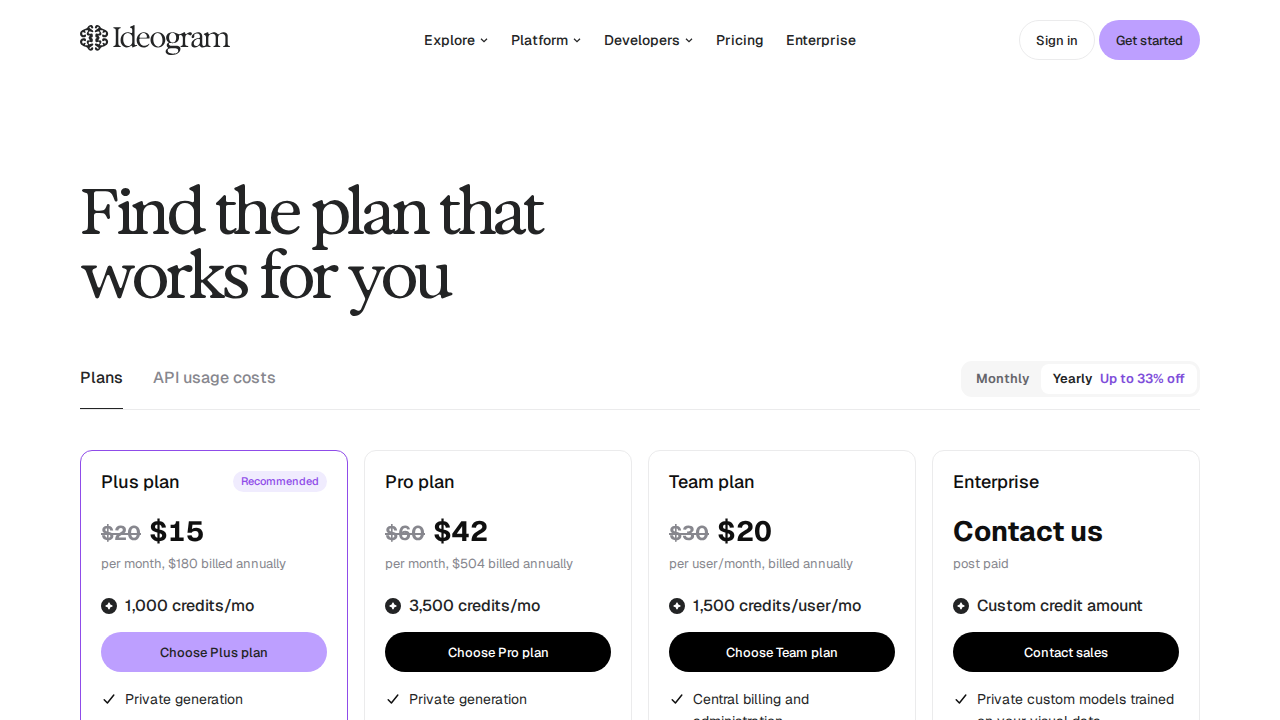
Paid plans start at approximately $7–8 per month according to third-party pricing trackers (figures verified as of mid-2026), with higher tiers reaching up to $60 per month for heavier usage and API access. Paid plans unlock private generations, priority queues, and higher generation limits.
Verify current plan pricing directly at ideogram.ai, as tiers can be updated without notice.
Pros and Cons
Pros
- Best-in-class text accuracy among mainstream AI image generators for most typography use cases
- Dedicated style modes (Logo, Poster, Marketing, Print) remove prompt complexity
- Text is synthesized natively — letterforms integrate with lighting and composition
- Free tier available for genuine evaluation before committing to a plan
- API access for developers and workflow integration
- 4.3 out of 5 on Trustpilot from verified users
Cons
- Competitors have closed the gap: GPT Image 1.5 and Seedream 4.5 now rival or exceed Ideogram on text rendering in 2026
- Single-model architecture — no video generation, no multi-model switching within the platform
- Free tier (slow queues, public images) is unsuitable for commercial use without upgrading
- Overall image quality ranks in the middle of the leaderboard when all criteria — not just text — are evaluated
- Subscription model with no meaningful pay-per-generation option for light users
Who Should NOT Use Ideogram
- Video creators — Ideogram generates static images only. No video generation is offered.
- Photorealism-first users — if lifelike photography is the priority rather than designed graphics with text, Midjourney v7 or FLUX.2 Pro may produce more natural results.
- Very occasional users — if you generate a handful of images per month, the free tier frustrations may outweigh the value and a paid subscription may not pencil out.
- Multi-model workflow users — Ideogram’s single-model architecture will not suit those who need to switch between image models inside one platform.
Verdict
Ideogram 3.0 remains the clearest choice when your primary requirement is text that reads correctly inside an AI-generated image. Logos, posters, signage, and marketing graphics with real typography are where it earned its reputation — and where it still delivers. The 90–95% text accuracy figure reported by independent sources reflects a genuine architectural advantage over general-purpose generators that still struggle with basic phrases.
That advantage is narrowing. GPT Image 1.5 and Seedream 4.5 have closed the gap in 2026, and Ideogram’s overall image quality sits in the middle of the field when evaluated broadly. But for the text-in-image use case specifically — the reason most people come to Ideogram — it remains a reliable, accessible default at a price point that works for professional use.
Bottom line: If you need AI-generated images with accurate readable text baked in, Ideogram is the low-friction first choice. If you need video, top-tier photorealism, or multi-model flexibility, look elsewhere.
FAQ
Does Ideogram render text better than Midjourney?
Yes, for most typography use cases. Midjourney is stronger on overall aesthetic quality and photorealism, but Ideogram is specifically architected for text accuracy and consistently outperforms Midjourney when correct, readable text inside the image is the priority.
Is there a free version of Ideogram?
Yes. The free tier is functional and sufficient for testing the tool before buying. Limitations include slower generation queues and public image outputs. Paid plans unlock private generations, priority queues, and higher monthly limits.
What is Ideogram 3.0 text accuracy?
Third-party sources report 90–95% text accuracy for Ideogram 3.0, meaning specified text appears correctly in the vast majority of generated images. Results vary with prompt complexity and length of the text being rendered.
Who are Ideogram’s main competitors in 2026?
For text-in-image work: GPT Image 1.5 (reported as the strongest overall text renderer as of 2026), Seedream 4.5, and Recraft V3. For general image generation: Midjourney v7 and FLUX.2 Pro.
Does Ideogram have an API?
Yes. API access is available on higher-tier paid plans, making it possible to integrate Ideogram generation into custom tools, automation workflows, and product features.