What is Ideogram?
Ideogram is an AI image generator built around one core strength: rendering readable, accurate text inside generated images. While most AI image tools still struggle with letters and words, Ideogram 3 achieves 90–95% text accuracy — making it the go-to platform for logo concepts, posters, marketing graphics, and any design where typography must be correct the first time.
Originally a niche tool, Ideogram has evolved into a full design platform used by freelancers, agencies, and brands. The latest version adds a real-time collaborative canvas, a brand kit that enforces your colors and logos, and dedicated style modes for logos, posters, marketing, and print work.
Key Features
Native Text Rendering
Unlike tools that composite text on top of an image as a post-process, Ideogram renders typography as part of the generation — letters curve with shapes, match the visual style, and integrate naturally into the composition. For logo concept work, this means your wordmark actually looks like it belongs in the design rather than sitting awkwardly on top of it.
Logo and Style Modes
Ideogram 3 ships dedicated generation modes: Logo, Poster, Marketing, and Print. Selecting Logo mode biases the model toward cleaner compositions, isolated subjects, and legible type — practical for designers who need quick concept drafts before moving into a vector editor.
Real-Time Canvas and Brand Kit
The collaborative canvas lets teams iterate on designs live without exporting files back and forth. The brand kit feature locks in your logo, color palette, and typography so every generation stays on-brand — useful for agencies managing multiple client accounts simultaneously.
Commercial Use on All Tiers
Ideogram grants full commercial rights to generated images on every paid plan, and on the free tier with attribution. You own the output and can use it in client work, merchandise, or advertising without per-project licensing fees. This is confirmed across multiple 2026 independent reviews.
Color Palette Control
On Plus and above you can input specific color palettes — rare among AI image tools and critical for brand-consistent logo work. Combined with Logo mode, this reduces the iteration cycles needed to hit a client’s color brief.
API Access
Developers and power users can access Ideogram via API at approximately $0.03 per image, enabling batch generation pipelines and integration into design tooling and automated workflows.
Pricing
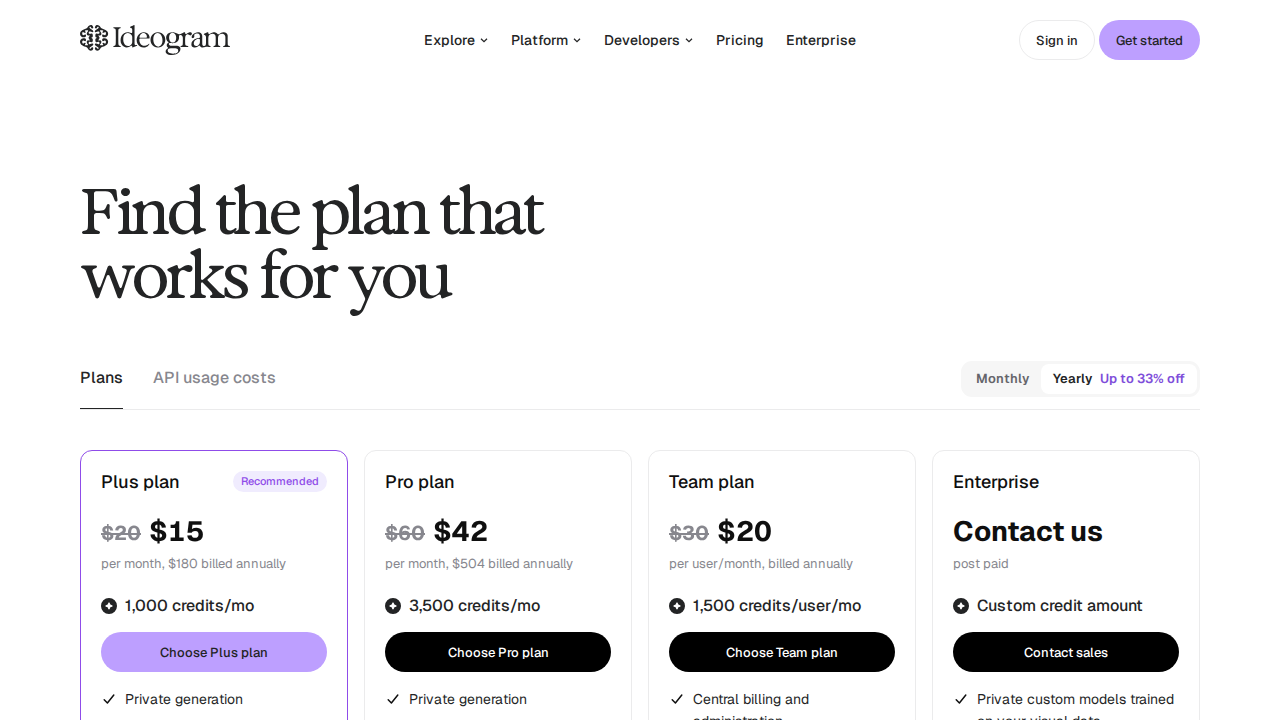
Ideogram offers a free tier and three paid plans. Figures below are drawn from multiple 2026 sources — always verify current rates on Ideogram’s official site before purchasing, as plan details have shifted through the year.
| Plan | Price | Credits | Key features |
|---|---|---|---|
| Free | $0 | ~10 slow credits/week | Public generations, commercial use with attribution |
| Basic | ~$8/mo | Priority queue access | Private generations, full commercial use |
| Plus | ~$20/mo | 1,000 priority credits/mo | Color palette control, image uploads, private generations |
| Pro | ~$40/mo | 3,500 priority credits/mo | Batch generation, brand kit, highest priority queue |
API: ~$0.03 per image. Annual billing reduces the monthly rate. Full commercial rights are included on all paid plans with no additional licensing layer.
For freelancers, one logo retainer ($200–$500) covers months of Plus subscription — the ROI calculation is straightforward for working designers.
Pros and Cons
Pros
- Best-in-class text rendering — 90–95% accuracy makes it reliable for production logo drafts and poster typography
- Commercial use included on all paid plans — full rights, no per-project licensing fees
- Dedicated Logo mode — purpose-built for design work, not a generic image generator repurposed
- Color palette input — rare among AI image tools; essential for brand-consistent client work
- Free tier available — enough credits to validate whether it fits your workflow before committing
- API access at $0.03/image — enables automation and integration into design pipelines
- Real-time collaborative canvas — useful for teams iterating on concepts together
Cons
- Raster output only — generated images are not vectors; you still need Illustrator or Inkscape to finalize a deliverable logo
- Text accuracy is 90–95%, not 100% — complex multi-word lockups or stylized letterforms sometimes need several attempts
- Narrower artistic range than Midjourney — photorealistic scenes and painterly illustration are not where Ideogram leads
- Credit budgets can run short on high-volume work — batch-heavy agencies may find even Pro tier credits limiting
- Pricing has shifted across 2026 — independent sources cite slightly different figures; always check the official site
Who Should NOT Use Ideogram
- Photographers and illustrators whose primary need is photorealistic or painterly output — Midjourney V7 or Adobe Firefly serve those use cases better
- Designers who need final production-ready vector files — Ideogram is a concept and draft tool, not an SVG output engine
- Teams requiring 100% text accuracy with zero iteration — at 90–95%, human review of text lockups is still mandatory before client delivery
- High-volume generative pipelines on a tight budget — API costs at $0.03/image accumulate quickly at scale
- Non-designers expecting a complete logo service — Ideogram generates visual concepts, not finished brand identities with strategy, variations, and file packages
Verdict
Ideogram 3 is the strongest AI tool in 2026 for logo concept generation and design work where text must be readable. The combination of native text rendering, a dedicated Logo mode, color palette control, real-time canvas, and full commercial rights on all paid plans makes it a practical addition to any designer’s workflow — not as a replacement for a vector editor, but as a fast concept-generation layer upstream of one.
The Plus plan at around $20/month is the sweet spot for individual designers: 1,000 priority credits, private generations, and color palette input cover the typical volume of an active freelancer. One logo retainer pays for the subscription many times over.
If text accuracy and brand consistency in AI-generated images are your bottleneck, Ideogram 3 solves that problem more reliably than any current alternative.
Sources Checked
- VibeDex — Ideogram Review 2026: Text Rendering King
- Piclumen — Ideogram AI Review 2026
- AI Tool Radar — Ideogram 3.0 in 2026
- Ship or Skip — Ideogram 3.0 (reviewed July 2026)
- ComparEdge — Ideogram Review 2026
FAQ
Does Ideogram 3 allow commercial use for logo design?
Yes. Ideogram grants full commercial rights on all paid plans. The free tier permits commercial use with attribution. You can use generated images in client deliverables, merchandise, advertising, and products without additional licensing fees.
How accurate is Ideogram’s text rendering for logo work?
Independent testing in 2026 places Ideogram 3 at 90–95% text accuracy. Most single-word or short-phrase prompts render correctly on the first try. Complex multi-line or heavily stylized text benefits from a few iterations. It remains the most reliable AI tool for text-inside-image generation available in 2026.
Can Ideogram replace a professional logo designer?
No. Ideogram generates raster concept drafts, not final production files. Professional logo delivery requires vector output, brand strategy, client revision rounds, and file preparation — none of which Ideogram handles end-to-end. It accelerates the concept phase; it does not replace the design process.
What Ideogram plan is best for freelance designers?
The Plus plan (around $20/month) is the most commonly recommended tier for individual designers: 1,000 priority credits per month, private generations, and color palette control. The free tier provides enough credits to evaluate the tool before committing.
How does Ideogram compare to Midjourney and Adobe Firefly for logo design?
Ideogram leads on text rendering accuracy and dedicated logo-mode output. Midjourney V7 produces more diverse artistic and photorealistic imagery but still struggles with accurate text in logos. Adobe Firefly integrates with Creative Cloud and offers strong commercial licensing clarity but also lacks Ideogram’s text-rendering edge. For design work where the typography must be readable and on-brand, Ideogram is the current benchmark.