What is Leonardo AI?
Leonardo AI is a browser-based image generation platform built for creative professionals, with roots in game art and concept design. Unlike most AI image tools, it centers on control: fine-tuned guidance, reusable character elements, a real-time canvas editor, and a growing library of specialized models trained for game assets, environments, and character art.
In the leonardo ai vs midjourney for game art debate, Leonardo occupies a clear niche: it trades some raw image quality for workflow tools that game artists actually need — consistent asset iteration, canvas editing, and a genuine free tier that Midjourney does not offer.
Key Features
- Specialized game art models — Purpose-built models including Phoenix, designed for game assets, concept art, and environment design
- Canvas editor — Real-time inpainting, outpainting, and element placement inside the browser without third-party tools
- Element consistency — Reusable character and object elements that stay visually coherent across a project
- Image guidance tools — Fine-grained control over composition, style, and structure not available in Midjourney
- Free tier — 150 fast tokens per day at no cost, making it accessible for indie developers and students
- API access — Developer-facing API for production pipelines, though some canvas features remain web-only
Leonardo AI vs Midjourney for Game Art
This comparison comes down to a clear trade-off: Midjourney V7 delivers superior image quality for most general prompts, while Leonardo AI offers specialized game-focused tooling that Midjourney simply does not have.
Where Leonardo AI wins for game art
- Game-specific models — Dedicated models trained on game art styles, compared to Midjourney’s general-purpose approach
- Asset consistency — Reusable elements keep a character or weapon visually identical across multiple generated images — critical for real game pipelines
- Free tier — Midjourney has no free plan; Leonardo gives 150 tokens per day at no cost
- Canvas editing — In-browser inpainting and outpainting vs. Midjourney’s web or Discord interface
- Workflow integration — Better suited for iterating on assets inside a production pipeline
Where Midjourney wins
- Raw image quality — Midjourney V7 outclasses Leonardo for photorealistic renders and high-quality mood boards
- Style range — Broader aesthetic coverage for concept art that does not need to match a specific game model
- Community and prompting culture — Larger sharing community makes it easier to find and adapt effective prompts
The consensus across multiple 2026 comparisons: if you are generating concept art references or mood boards, Midjourney often wins. If you are building consistent game asset sets, need iteration on a budget, or want to test before paying, Leonardo AI is the stronger tool for game developers.
Pricing
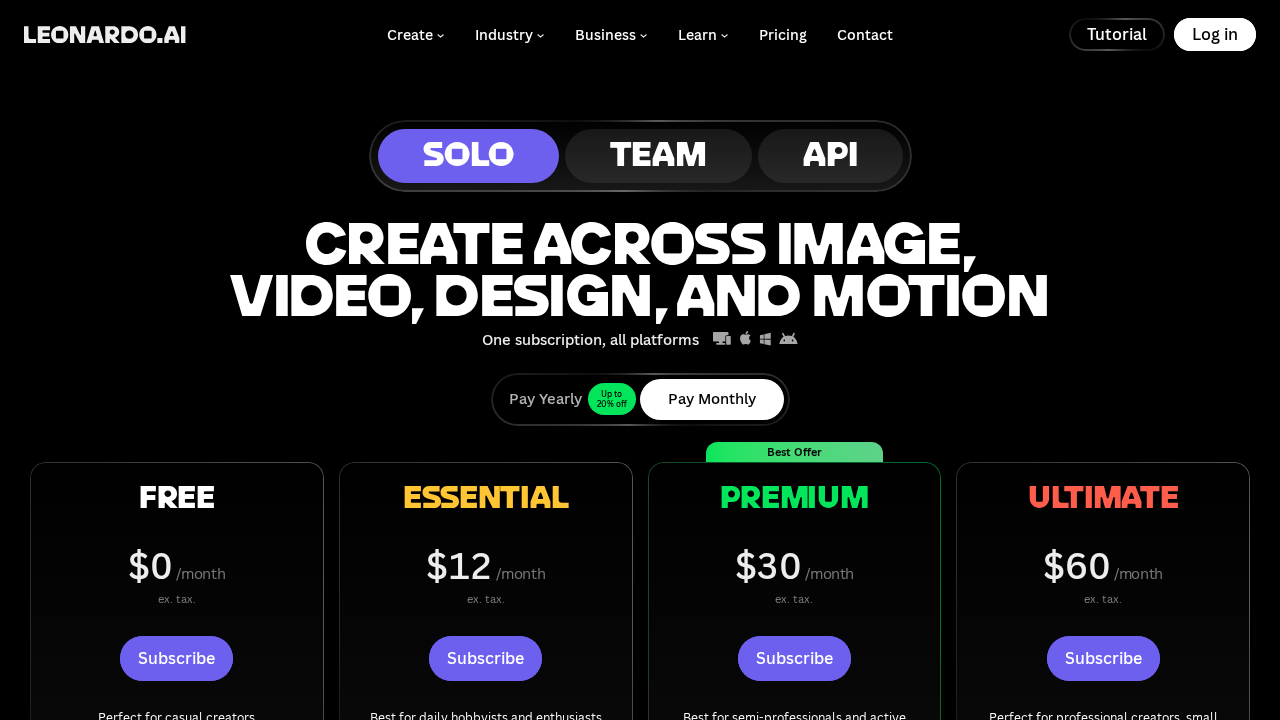
Leonardo AI offers a genuine free tier — a significant differentiator vs. Midjourney, which has no free plan:
- Free — $0/month. 150 fast tokens per day, public creations, basic quality settings, 1 personal collection. No credit card required.
- Essential — $12/month. Expanded token bank, higher quality settings, private creations.
- Team and API plans — Available for studios and developers; see leonardo.ai/pricing for current rates.
Note: token accounting has generated some user complaints around transparency. Review the current pricing page carefully before upgrading, and confirm what counts toward daily limits on your specific plan.
Pros and Cons
Pros
- Free tier with 150 daily tokens — no credit card needed
- Specialized game art and concept art models
- Built-in canvas editor for inpainting and outpainting
- Element consistency tools for cohesive asset sets across a project
- Browser-based — no Discord or external app required
- API available for developer and studio pipelines
Cons
- Raw image quality trails Midjourney V7 for general and photorealistic use cases
- Some features locked to the web UI and not accessible via API
- Token accounting can be confusing; some users report unexpected limits
- Moderation stricter than some competitors for certain creative content
- No native video generation
Who Should NOT Use Leonardo AI
- Artists who prioritize maximum image quality above all else — Midjourney V7 is the better choice for pure aesthetic output and high-fidelity concept art
- Developers who need full API feature parity — Canvas editing and several model options are web-only
- Teams building video content — Leonardo AI focuses on images; dedicated video generation tools will serve you better
- Production workflows needing large-scale batch processing — API-first alternatives offer more headroom for batch pipelines
Verdict
In the leonardo ai vs midjourney for game art comparison, there is no universal winner — it depends on your workflow stage.
Leonardo AI is the stronger choice for game asset production: specialized models, canvas editing, element consistency, and a real free tier make it the more practical tool for indie and mid-size studios building actual game content. Midjourney wins on concept art quality and early-stage ideation, where raw aesthetic output matters more than workflow tooling.
For most game developers, the practical answer is to use both: Leonardo for consistent, iterable game assets and Midjourney for high-quality reference art. If you can only choose one and want to start without a paid subscription, Leonardo AI is the obvious first stop.
Rating: 8.2 / 10 for game art use cases.
Sources checked
- Maginary.ai — Leonardo AI vs Midjourney (2026)
- Morphic — Leonardo vs Midjourney comparison
- TechBothQ — Midjourney vs Leonardo AI 2026
- Leonardo.ai — Official pricing page
- N-hance School — Midjourney vs Leonardo AI for Game Art
FAQ
Is Leonardo AI free to use?
Yes. Leonardo AI has a free plan at $0/month that includes 150 fast tokens per day. No credit card is required to get started.
Is Leonardo AI better than Midjourney for game art?
For game asset production — consistent characters, weapons, and environments — Leonardo AI has purpose-built tools (specialized models, canvas editor, element consistency) that give it a workflow edge. For concept art quality and mood boards, Midjourney V7 typically produces better raw output. Most game developers benefit from using both tools at different stages.
Does Leonardo AI have an API?
Yes. Leonardo AI offers an API plan for developers and studios. However, some features — including canvas editing and certain model options — are only accessible through the web interface, not the API.
What is Leonardo AI’s Phoenix model?
Phoenix is one of Leonardo AI’s dedicated image generation models, designed for high-quality creative output. It is part of Leonardo’s library of specialized models that target specific art styles and use cases beyond general-purpose generation.
Can I use Leonardo AI commercially?
Commercial licensing terms vary by plan. Check leonardo.ai/pricing and the current terms of service for details specific to your subscription tier, as these can change over time.