The Three Contenders at a Glance
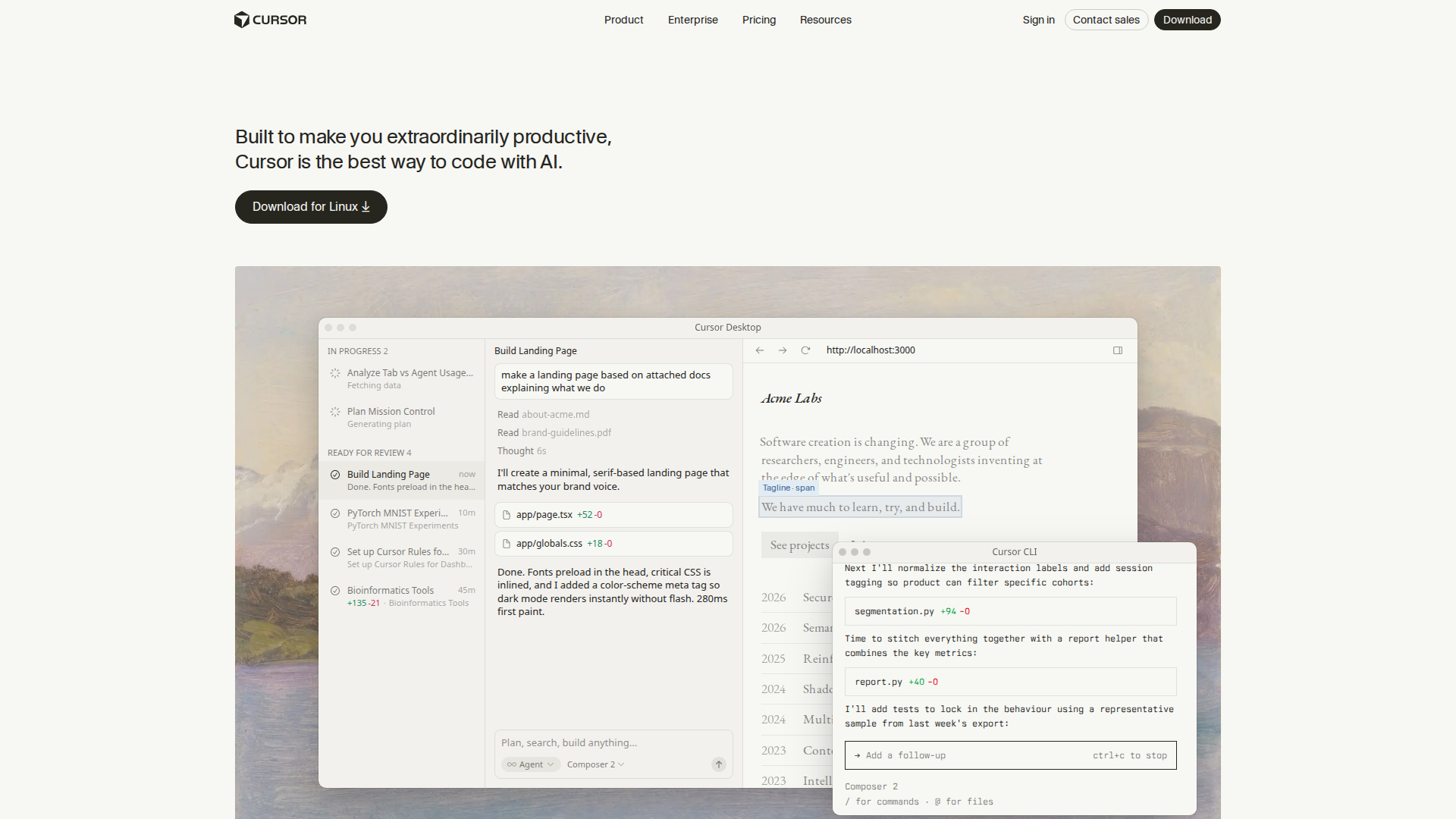
By mid-2026, the AI coding agent market has settled into three mature, well-funded incumbents that could hardly be shaped more differently. Claude Code is a proprietary, terminal-native agent built for deep reasoning and long autonomous sessions. OpenAI Codex is sandboxed, cloud-first, and optimized for running tasks in parallel. Cursor is an IDE-style editor that delivers AI edits as reviewable diffs — the least workflow disruption of the three.
Key Features
Claude Code
- Terminal-native agent with deep codebase reasoning
- Leads on autonomous session length for complex, multi-step tasks
- 3,000+ MCP (Model Context Protocol) integrations
- Sandboxing via /permissions control
- GitHub code review and Slack integrations on paid plans
- API path available for CI and shared environments, billed per token
OpenAI Codex
- Best for parallel task execution across multiple repos or environments
- Cloud-sandboxed by default — safer for unreviewed execution
- Strong integration with the ChatGPT ecosystem
- GitHub code review features on higher plans
- Designed for async, background task workflows
Cursor
- VS Code-style editor with repo-wide context awareness
- AI edits land as reviewable diffs — you stay in control
- Best for developers who want IDE-centric daily workflows
- Strong enterprise control and auditability features
- Familiar onboarding for teams already on VS Code
Pricing
Claude Code
Claude Code is included with the Claude Pro plan ($20/month) and higher Max plans. An API key path is also available, billed per token, designed for CI pipelines and shared environments — without the cloud UI features like GitHub code review and Slack. Enterprise and Edu pricing is available by contract.
OpenAI Codex
Codex pricing follows your ChatGPT plan: Free ($0), Go ($8/month), Plus ($20/month), Pro ($100/month), Business ($20/user/month billed annually or $25/month billed monthly), and Enterprise or Edu by contract. An API key path is a separate option billed per token.
Cursor
Cursor offers a free tier for individual developers and paid plans aimed at teams and enterprise buyers. Enterprise tiers focus on compliance, audit logs, and VPC deployment. Check the Cursor website directly for current plan prices, as they have evolved through 2026.
Pros and Cons
Claude Code
| Pros | Cons |
|---|---|
| Best autonomous session length | Terminal-only — no GUI editor |
| 3,000+ MCP integrations | Requires comfort with CLI workflows |
| Deep reasoning on complex codebases | API token costs scale with heavy use |
| Strong sandboxing via /permissions | Steeper learning curve for IDE-first developers |
OpenAI Codex
| Pros | Cons |
|---|---|
| Best for parallel task execution | Pro plan ($100/mo) expensive for solo devs |
| Cloud-sandboxed by default | Less suited for long, interactive reasoning sessions |
| Deep ChatGPT ecosystem integration | API path loses cloud UI features |
| Async background workflows | Can feel disconnected from local dev environment |
Cursor
| Pros | Cons |
|---|---|
| Familiar VS Code-style editor | Less suited for fully autonomous long-running tasks |
| Reviewable diffs — you stay in control | Enterprise features require higher-tier plans |
| Repo-wide context awareness | More developer oversight needed than agent-first tools |
| Best enterprise control and auditability | Still an IDE switch for non-VS Code users |
Who Should NOT Use These Tools
- Claude Code — Not for developers who need a GUI editor or prefer reviewing every change as a visual diff before it touches the repo. If you live in VS Code, the terminal workflow will feel foreign.
- OpenAI Codex — Not ideal if you need deep, interactive back-and-forth reasoning on a single complex task. It shines at async, parallel workloads — not extended collaborative sessions.
- Cursor — Not the right fit if you want fully autonomous, long-running agent sessions that execute without constant developer oversight. It is built around the developer staying in the loop.
Verdict
Claude Code wins if you want the deepest autonomous coding sessions, the widest integration surface (3,000+ MCP), and are comfortable working in the terminal. OpenAI Codex wins if your workflow is async and parallel — spinning up multiple tasks across repos simultaneously on a predictable subscription budget. Cursor wins if you want AI assistance without abandoning the IDE experience: reviewable diffs, repo-wide context, and the lowest friction for teams already on VS Code.
There is no single winner in 2026. The right tool depends entirely on how you work. If autonomy and depth matter most, pick Claude Code. If parallel throughput and ChatGPT ecosystem integration matter, pick Codex. If IDE comfort, team control, and enterprise auditability matter, pick Cursor.
Sources Checked
- OpenAI Codex Review 2026 — NxCode
- Codex vs Claude Code 2026: Benchmarks, Pricing & Verdict — Duet
- Claude Code vs Codex vs Cursor — Cosmic JS
- Claude Code vs Cursor vs Codex 2026 — AIToolsRecap
- Claude Code vs Cursor vs OpenAI Codex — RecaTools
FAQ
Is Claude Code free?
Claude Code is included with the Claude Pro plan at $20/month. A limited free tier exists under the base Claude plan. API access is billed separately per token and does not include the cloud UI features.
Is the 2026 Codex the same as the original OpenAI Codex model?
No. The 2026 Codex is a cloud-based coding agent, distinct from the original Codex language model. It runs tasks in sandboxed cloud environments and its pricing is bundled with your ChatGPT subscription plan.
Can I use Cursor for free?
Cursor offers a free tier for individual developers. Team and enterprise plans add compliance, audit logs, and collaboration features. Check the Cursor website for current pricing as plans have evolved in 2026.
Which tool is best for enterprise teams?
Cursor leads on familiar IDE workflows and enterprise control. Codex offers Business and Enterprise plans with shared environments and compliance features. Claude Code supports enterprise via API and contract pricing with strong sandboxing controls.
Which AI coding agent performs best in 2026?
Multiple independent sources note Claude Code leads on autonomous session length and integration breadth. Codex leads on parallel task throughput. Cursor leads on reviewable, controlled code delivery. No single tool dominates every metric — the winner depends on your workflow.